China reverses course on whether it will cooperate with WHO coronavirus origins probe
CCP FABRICATED ‘Swiss Biologist’ Who ‘Claimed US Had Pressured WHO into Investigating Wuhan Covid lab Leak Theory’
VIDEO: Top Gain of Function Scientist Ralph Baric Admitted Viruses Can Be Lab Engineered ‘Without a Trace’
COVID-19 gene data removed from NIH database on Chinese researchers’ request
China’s ‘massive cover-up’ on COVID still happening: WHO advisory board member
Blinken: China’s early ‘failure’ on Covid cooperation helped speed pandemic
UK and US criticise WHO’s Covid report and accuse China of withholding data
Right
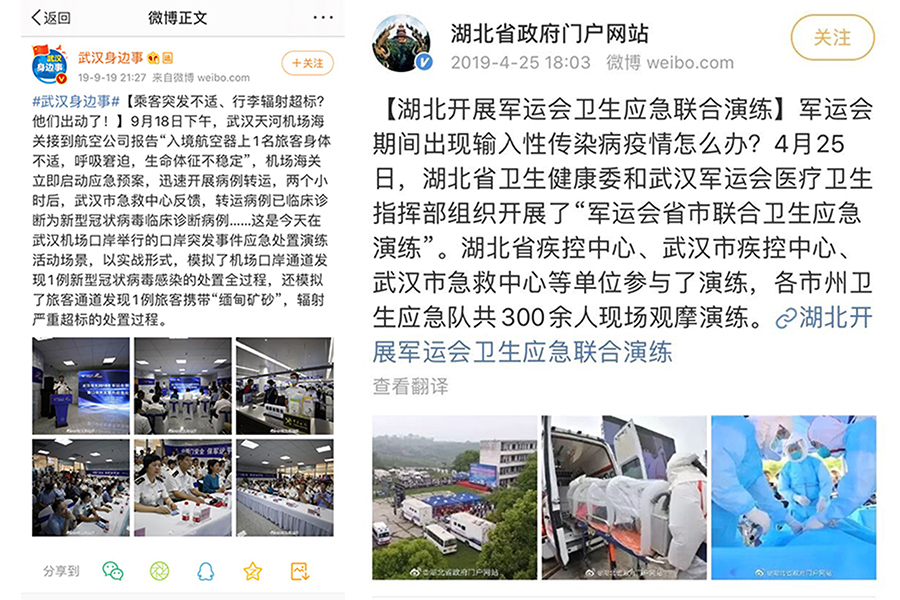
Hubei Provincial Government Portal on Weibo.com
25 April 2019, 18:03
[Hubei Conducts Joint Health Emergency Drill for the Military World Games]
What if there is an imported infectious disease epidemic during the military games? On 25 April, the Hubei Provincial Health Commission and the Wuhan Military World Games Medical and Health Command organised a joint provincial and municipal health emergency drill for the games. The Hubei Provincial CDC, Wuhan CDC, Wuhan Emergency Medical Center and other units took part, and more than 300 people from various cities and prefectures watched the drill on site.
Left
Things around in Wuhan
19 September 2019, 21:27, from weibo.com
[Passengers suddenly sick, luggage radiation overload? They’re out in force!]
On the afternoon of 18 September, Wuhan Tianhe Airport Customs received a report from an airline that “a passenger on the inbound aircraft was unwell, in respiratory distress and with unstable vital signs”. The airport customs immediately launched an emergency plan to carry out the patient transfer, and two hours later the Wuhan Emergency Medical Centre reported that the transferred patient had been clinically diagnosed as a case of a novel coronavirus. This was the scene of an emergency-response drill held that day at the Wuhan airport port of entry, staged as a real battle, simulating the handling of a case of novel coronavirus infection found at the airport entry channel, and also simulating the handling of a passenger found carrying “Burmese mineral ore” with radiation severely over the limit.
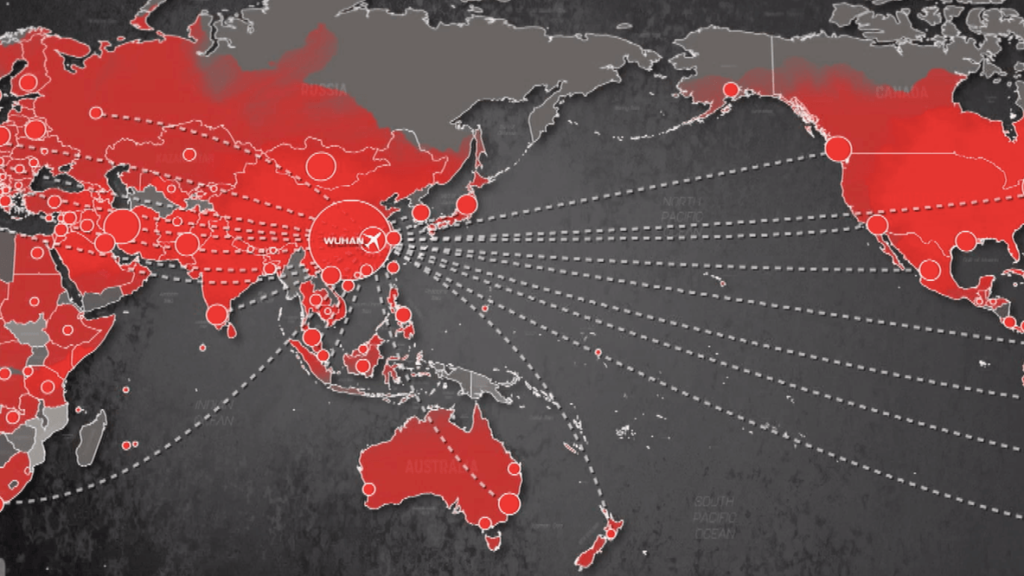
Key Events Before February 2020
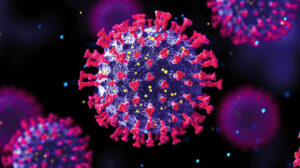
A year later, the world remains in the grip of a global pandemic known as COVID-19. The 2019 coronavirus disease (COVID-19) is caused by a strain of coronavirus similar to SARS-CoV, the strain behind the 2003 SARS pandemic, and so the virus has been designated SARS-CoV-2.
The COVID-19 global pandemic could have been prevented if the CCP had acted in a transparent and responsible manner.
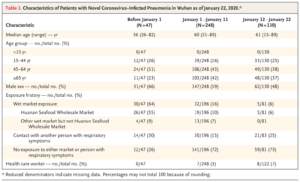
According to a retrospective study published in The Lancet on 24 January 2020, the earliest laboratory-confirmed case of COVID-19 in Wuhan was a man whose symptoms began on 1 December 2019. No epidemiological link could be found with other early cases, and none of his family fell ill. The virus was nonetheless believed to have first appeared some time in November; the earliest case identified by CCP authorities can be traced back to 17 November 2019.
According to a later report, the CCP authorities said they were told of a SARS-like disease by a doctor at a provincial hospital in Hubei. The CCP controls everything in China, so it should have known about the outbreak before 1 December 2019, but it covered it up to keep the outside world in the dark. By this point, cases were multiplying.
The health commission in Wuhan notified local hospitals of a “pneumonia of unclear cause” and asked them to report any suspicious cases from the past week. Dr Ai Fen, a senior doctor at Wuhan Central Hospital, received test results from a patient with a suspected coronavirus, photographed them and sent the photo to another doctor; it spread through Wuhan's medical community. Dr Li Wenliang, a 34-year-old ophthalmologist in Wuhan, posted a message in a WeChat group late in December warning fellow doctors of a new disease, writing that seven patients had SARS-like symptoms and were in quarantine, and advising colleagues to protect their families and wear protective equipment.
CCP officials confirmed they were investigating 27 cases of viral pneumonia and sent a team of health experts to the region. According to the retrospective study in The Lancet of 24 January 2020, there were already 47 cases, so the CCP had lied. China still did not inform the WHO of the outbreak. It was the first time the CCP publicly acknowledged an unidentified infection, yet it kept insisting the “pneumonia of unclear cause” was preventable and controllable. Authorities said seven people were in a critical condition but that no human-to-human transmission had been identified.
A Wuhan hospital posted on WeChat that it was “fighting a mysterious pneumonia”. Dr Ai Fen said she was reprimanded by a hospital disciplinary committee for “spreading rumours”, and Dr Li Wenliang was summoned to a Wuhan public security office for “spreading false rumours” and forced to sign a statement admitting “false comments” that “disrupted social order” and agreeing not to discuss the disease further.<br /><br />On Weibo, Wuhan police said they had taken legal action against people who “published and shared rumours online”, “causing a negative impact on society”. The next day CCTV, the CCP-controlled state broadcaster, picked up the story without noting that the eight accused of “spreading false rumours” were doctors. Authorities shut down the Huanan Seafood Wholesale Market, the site of a number of cases, successfully diverting attention to the market in order to hide the virus's true origin.<br /><br />Officials ordered the Huanan market closed and sanitised, destroying forensic evidence that might have revealed where the outbreak began. An official of the Hubei Provincial Health Commission ordered gene-sequencing companies and labs to stop testing and destroy patient samples. The next day, scientists at the Wuhan Institute of Virology (WIV) finished mapping the genome of SARS-CoV-2 but neither published the data nor informed the WHO.
Various allegations gained traction on Chinese social media, such as local health authorities silencing hospital staff. Wuhan's health authorities said they were investigating the cause of the outbreak and that there had been no human-to-human transmission. On 3 January the National Health Commission issued a nationwide order, like the Hubei one, requiring that virus samples be destroyed. The CCP refused to acknowledge this order until 15 May 2020.
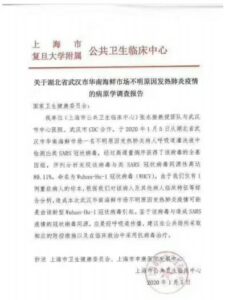
A second laboratory, at a research institute in Shanghai, told China's National Health Commission that it had fully mapped the virus's genome and found it similar to SARS-CoV. For a second time, the CCP failed to notify the WHO that Chinese researchers had identified the virus, sequenced its genome, and found it genetically close to the virus behind the 2003 SARS pandemic.
China's top leaders, including President Xi Jinping, discussed the outbreak at a meeting of the Politburo Standing Committee, showing they knew of the virus from an early date.
A team of experts from the National Health Commission identified a novel coronavirus as the cause of the epidemic.
The CCP made the coronavirus genome public, proving its link to the SARS and MERS viruses. Scientists could now develop tests, but the genome the CCP released was incorrect. On 14 January the CCP again uploaded a new, incorrect sequence. By 17 January, when other countries had found the virus, they had no choice but to upload the correct sequence.
The CCP held its important annual political meetings for Hubei province, and lied again, still insisting that no human-to-human transmission had been identified. Because it covered up the problem, no increase in cases was reported during this period. Yet according to the retrospective study in The Lancet of 24 January 2020, there were in truth 248 cases of viral pneumonia between the 11th and the 17th, and seven health-care workers were infected. According to Dr Yan, community spread had already occurred.
The first case outside China was confirmed. The WHO said a traveller from Wuhan was identified by officials in Thailand on 8 January and taken to hospital that day.<br /><br />The WHO, which had been bought by the CCP, posted on Twitter that “preliminary investigations conducted by the Chinese authorities have found no clear evidence of human-to-human transmission.” A patient returned to the United States from Wuhan and became the first known US case of COVID-19. On the same day, the CCP's team of hundreds of trade negotiators were signing phase one of the trade agreement with the US government.
In the early morning Beijing time, Wuhan's health authorities reported 136 new confirmed cases while still maintaining there had been no human-to-human transmission. By that evening, a group of health experts at China's National Health Commission confirmed the virus was capable of human-to-human transmission, as cases had been found elsewhere in the country.
Wuhan was placed into lockdown.
The final report of the U.S. House Foreign Affairs Committee Minority Staff, titled “The Origins of the COVID-19 Global Pandemic, Including the Roles of the Chinese Communist Party and the World Health Organization”, concluded that, on an examination of the early stages of the outbreak, the efforts to conceal the spread and novel nature of the virus, the failures to share accurate information as required by international law, and the suppression of those seeking to warn the world, the CCP bears overwhelming responsibility for allowing a local outbreak to become a global pandemic.
Senior CCP leaders, including General Secretary Xi Jinping, knew a pandemic was under way weeks before they warned the public. Research shows the CCP could have cut the number of cases in China by up to 95% had it met its obligations under international law and mounted a public-health response earlier.
By 18 December 2020 there were more than 75.1 million confirmed cases across almost every country, and more than 1,660,000 people had reportedly died of COVID-19.